

Coffee Concrete: RMIT’s Biochar Innovation Wins Sustainability Award
RMIT University’s innovative coffee concrete has won the 2024 Universities Australia Shaping Australia Award in the Problem Solver – People’s Choice category for its groundbreaking use of biochar from spent coffee grounds to strengthen concrete by 30% while reducing landfill waste. With global sand demand expected to rise by 45% over the next four decades, this sustainable solution replaces a portion of sand in concrete, promoting waste reduction and resource conservation. Already tested in real-world applications, including Victoria’s Big Build projects and a footpath trial in Gisborne, this Australian-led research is gaining global recognition, featured in Germany’s Futurium Museum and supported by industry leaders like Ambiolock (Australia) and C-Green (Sweden). With commercialization efforts underway, coffee biochar could soon become a key ingredient in low-carbon, high-durability concrete solutions worldwide.
Full story: https://www.azobuild.com/news.aspx?newsID=23725

Concrete as a Carbon Sink: Japan’s Structures Absorb 14% of Cement Emissions
Japanese researchers from Tokyo and Nagoya Universities have found that Japan’s concrete structures absorb about 14% of the CO₂ emissions generated during cement production through carbonation—a natural process where concrete captures CO₂ when exposed to air. Their study, published in the Journal of Cleaner Production, estimates that from 1870 to 2020, over 135 million tonnes of CO₂ were absorbed by buildings, with 2.6 million tonnes captured in 2020 alone. While carbonation can contribute to steel reinforcement corrosion, the research highlights the role of concrete as a carbon sink, reinforcing the need for extending the lifespan of infrastructure to enhance sustainability in construction.
Full story: https://www.knowesg.com/environment/concreate-buildings-in-japan-act-as-carbon-sinks-study-06032025

Goat Hair Reinforced Concrete: A Natural Boost for Strength and Sustainability
Researchers at Gdansk University of Technology have found that incorporating goat hair fibers into lightweight concrete enhances both compressive and flexural strength, offering a sustainable and durable reinforcement alternative. In a study using CEM II/B-V cement, granulated glass aggregates (GGA), and lightweight sintered ash (LSA), composites with 0.8% goat hair achieved a 21.8% increase in flexural strength, while 0.4% goat hair improved compressive strength by 21.5% over 28 days. The research highlights the potential of natural fibers in reducing shrinkage and improving mechanical performance, making concrete more resilient while lowering environmental impact. Further studies could optimize fiber proportions and water-to-cement ratios to enhance workability and broader adoption in eco-friendly construction materials.
Full story: https://www.azobuild.com/news.aspx?newsID=23732
ACT Cement: A 70% Carbon Reduction in Concrete
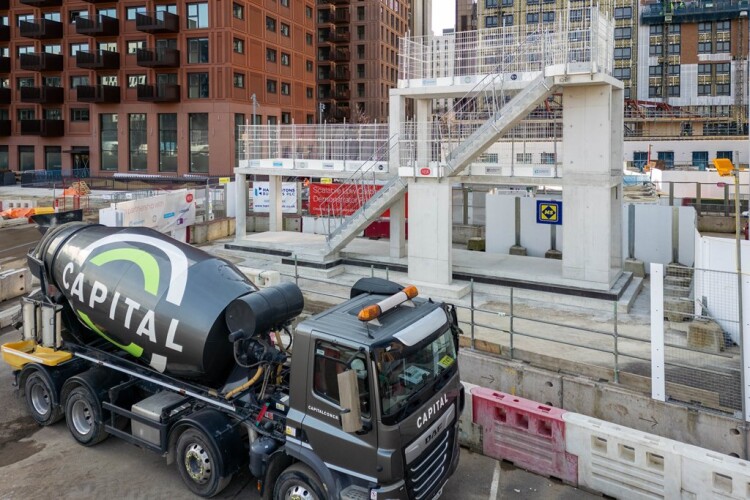
A Wembley Park trial has shown that Ecocem’s ACT cement alternative cuts carbon emissions by 70% compared to standard concrete. Funded by £500,000 from Innovate UK, the project used ACT-based concrete for floors, precast stairs, columns, and walls—all meeting design specs while significantly reducing embodied carbon.
Led by Sisk, in partnership with Ecocem, Ramboll, Loughborough University, Creagh Concrete, Capital Concrete, and BRE, the trial highlights ACT’s scalability. Ecocem is expanding production with a £42 million Dunkirk facility, set to produce 300,000 tonnes annually.
With proven workability, durability, and strength, ACT cement is a game-changer for low-carbon construction, but updated concrete standards are needed to accelerate adoption.
Full story: https://www.theconstructionindex.co.uk/news/view/wembley-concrete-trials-shows-70-carbon-savings
Blue Planet Achieves World’s First Net Zero Embodied Carbon Concrete Pour
On February 7, 2025, Blue Planet made history by completing the world’s first net zero embodied carbon concrete pour at the San Francisco Bay Aggregates Global Innovation Center in Pittsburg, CA. This milestone demonstration showcased Blue Planet’s patented carbon-sequestering technology, which replaces 75% of standard aggregate with synthetic limestone, turning concrete into a carbon sink.
With CEO Brent Constantz leading the charge, the event highlighted the real-world application of carbon-negative concrete, proving its potential for large-scale adoption. As Blue Planet continues to scale up, this breakthrough marks a major step forward in sustainable construction and the future of low-carbon concrete.
Check out the full video:
Let me know what you think of these hot topics and any others you have come across!
Also, don’t forget to subscribe to stay up to date with the latest concrete information.
 Alen Keri
Leave a comment