

With nearly a decade of experience in creating and optimizing concrete mix designs using advanced software in the ready-mix industry, along with preparing mix design submittals, I wanted to explore how effectively AI could design a concrete mix for a specific application while adhering to all necessary national standards.
This process is highly intricate, requiring a deep understanding of Canadian national standards (CSA A23.1/.2 – Concrete Materials and Methods of Concrete Construction/Test Methods and Standard Practices for Concrete) and all relevant performance criteria. Additionally, comprehensive knowledge of strength, durability, permeability, freeze-thaw and chloride resistance, and placement requirements is essential to ensure the mix design fulfills the specific needs of its intended application.
CSA A23.1:19/CSA A23.2:19
Concrete materials and methods of concrete construction/Test methods and standard practices for concrete
Published by CSA Group
English, French
Publication Year 2019
The process was initiated by using ChatGPT 4, and the following prompt as a starting point:

The result was quite surprising, as it not only demonstrated an understanding of the CSA A23.1 2019 standard but also accurately recognized the requirements for Class C-1 concrete. It effectively linked the appropriate exposure class with key performance criteria, including durability, freeze-thaw resistance, and chloride resistance.

The only additional performance criterion it suggested was sulfate exposure, which wasn’t required in this case but could become relevant if sulfates are present in the soil. In such a situation, the exposure class would shift from “Class C” to “Class S” concrete which does have additional durability requirements.
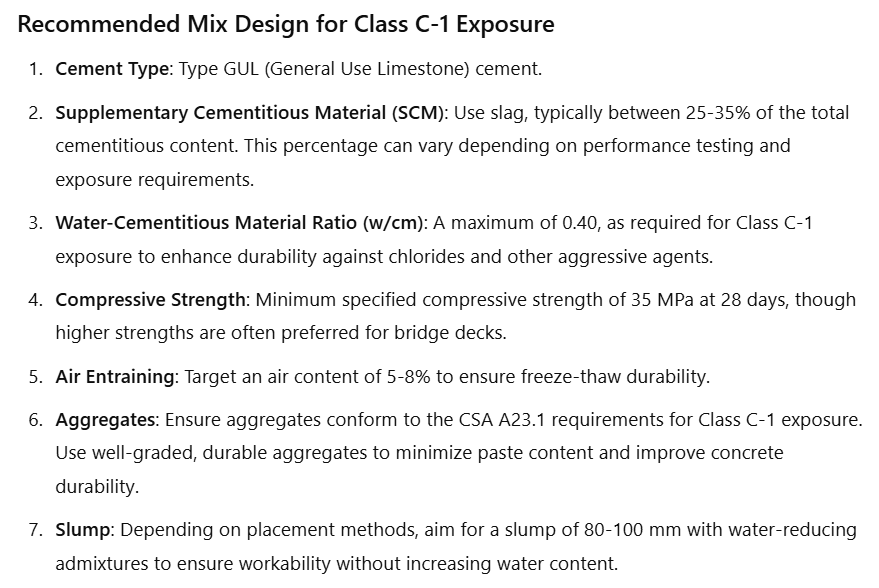
Next the AI provided a recommended mix design for Class C-1 exposure.
After reviewing the suggested mix design, here is my feedback based on nearly a decade of experience in creating concrete mix designs in the industry.:
- It incorporated the specified cement type, Type GUL, as initially indicated in the design requirements provided in the prompt.
- For the SCM content, it recommended a slag content of 25-35%, which is essential for long-term durability. However, one omission was that Class C-1 concrete must meet a chloride ion penetrability requirement of < 1500 coulombs within 91 days. This crucial durability performance criterion can typically be achieved with the suggested 25-35% slag content.
- The water to cementitious materials ratio (w/cm) was set at maximum 0.40, which is accurate and essential to meet both the previously mentioned penetrability requirement and the strength requirement.
- The compressive strength was set at 35 MPa at 28 days, which would have been correct under the 2009 version of CSA A23.1. However, in 2014, this requirement was adjusted to 35 MPa within 56 days, a standard also maintained in the 2019 edition referenced in the prompt. Consequently, the AI applied a more stringent requirement for Class C-1 concrete than necessary.
- The air content target was set at 5-8%, which is appropriate for 19 mm aggregate. Although the aggregate size wasn’t specified, assuming 19 mm is reasonable, as it is the most commonly used size for this type of mix design.
- Generic aggregate information was provided, which is acceptable, though it would have been helpful to mention the assumption of 19 mm aggregate here.
- Given that the placement method wasn’t specified in the prompt, the typical 80-100 mm slump range with a water reducer is a suitable starting point.
Overall, the suggested mix design is highly accurate and aligns well with CSA A23.1 2019 requirements. Nothing appears unexpectedly off, and the AI has proven to be reliable in its design approach.
Beyond the basic requirements, the AI has suggested the following additional considerations:

Once again, these suggestions are valuable, as a corrosion-inhibiting admixture is often used with Class C-1 concrete to provide extra chloride protection. Curing is essential not only for Class C-1 concrete but for any concrete, as it plays a key role in ensuring long-term durability and should always be considered.
In summary, the AI demonstrated a thorough understanding of the specified standard and effectively connected the requirements for the exposure class and intended application. The information could have been easily transferred to a mix design submittal without raising any concerns about performance criteria. Overall, ChatGPT-4 has proven to be highly reliable in this case, accurately interpreting the Canadian national standard for concrete and providing comprehensive information on strength, durability, freeze-thaw resistance, and chloride resistance.
Let me know your thoughts and if I should explore further AI analysis of mix designs! Don’t forget to subscribe to get notified directly by email about the next post!

 Alen Keri
Leave a comment