

On October 15th, the GCCA held a soft launch of the industry’s definition of “low carbon concrete” through a one-hour webinar. The session featured presentations by GCCA staff including Nicolas Antoniou, Sustainable Design and Construction Manager, and Dr. Andrew Minson, Sustainable Design and Construction Director.
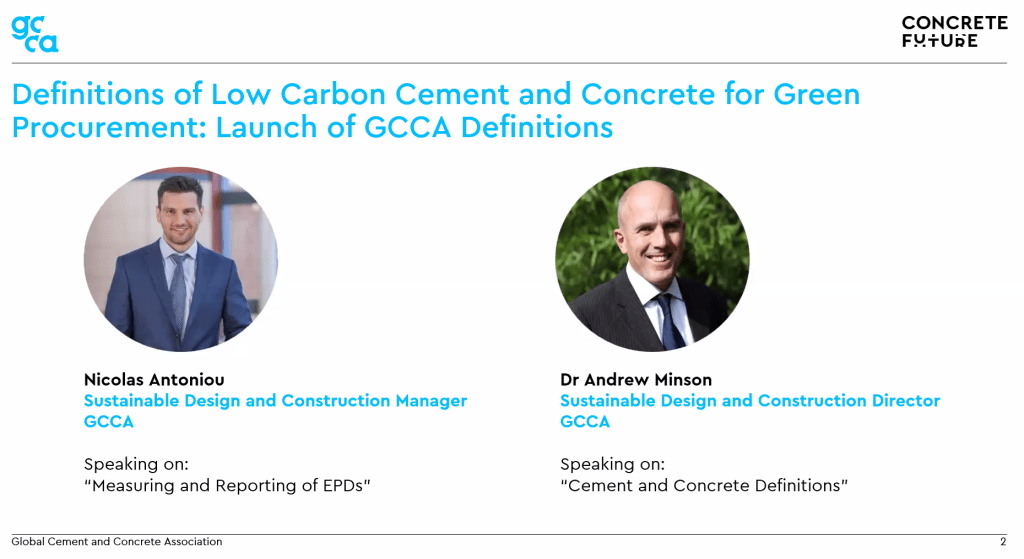
Both speakers provided insights into the framework, outlining the categories of low carbon concrete and highlighting the importance of aligning the industry around a global definition. Although a formal definition was not provided during the webinar, the low carbon concrete categories offer key insights, with more details to be shared at the official launch, which will take place at COP29 in Baku, Azerbaijan, from November 11-22, 2024.
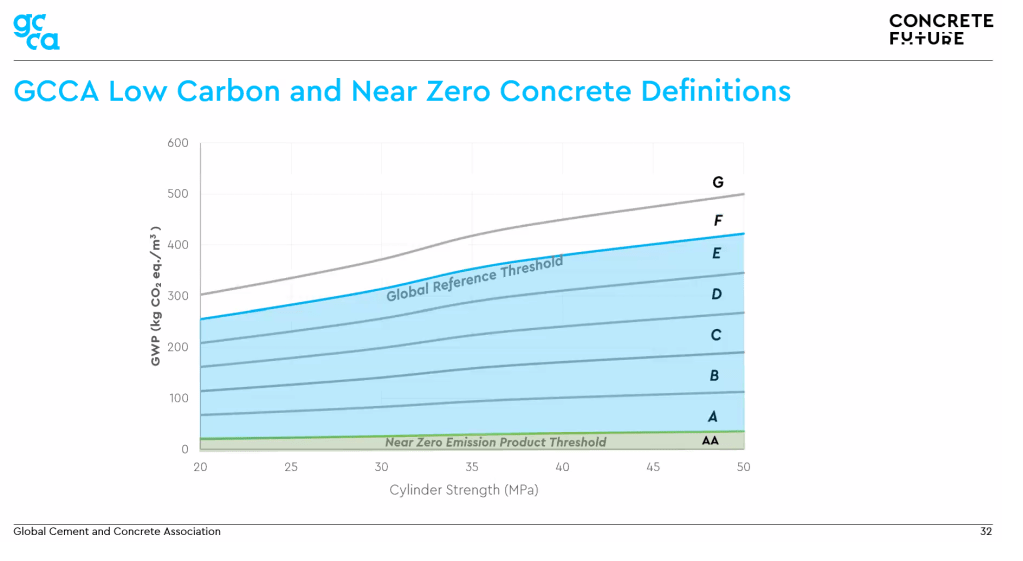
The categories are based exclusively on strength classes rather than exposure classes and conditions, as including these would add extra performance criteria. Additionally, five low carbon emission bands (A-E) have been established with equal ranges. The final band, labeled AA, represents the “near zero” category, defined by the projected impact of concrete in 2050. This band uses IEA cement GWP data as a basis, incorporates the Global Roadmap 2050 forecasts, and assumes no contribution from any constituents or processes except for cement.
Currently, the categories apply only to ready-mix concrete, with precast concrete set to be addressed in the near future.
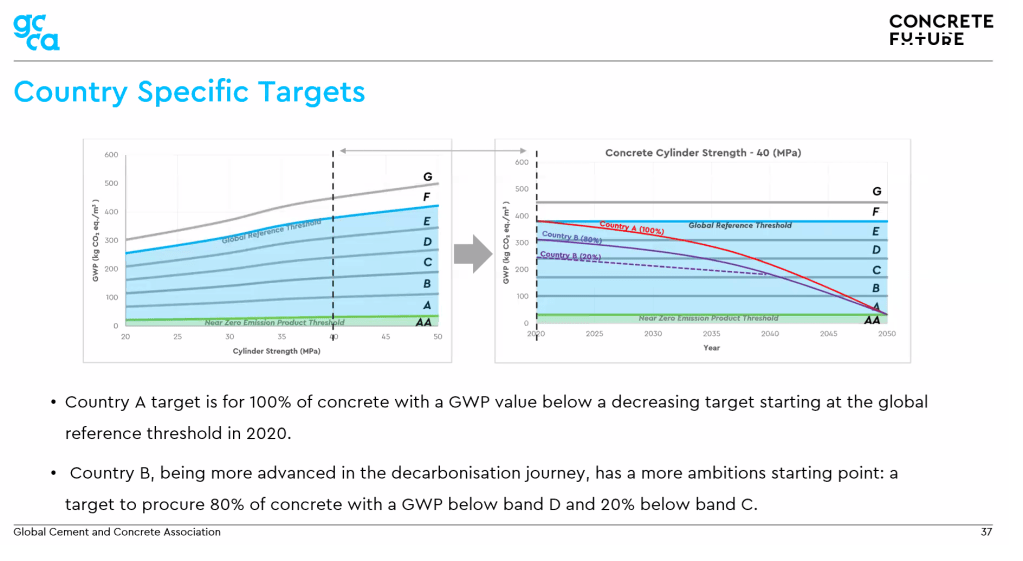
The purpose of these categories is for countries to tailor them to their specific current impacts and establish an appropriate starting point. For example, as shown below, a 40 MPa concrete mix from 2020 in Country A may begin at category F (with a GWP of 400 kgCO2/m3), while Country B, which is further along in its decarbonization efforts, might start at category E (with a GWP of 300 kgCO2/m3). Each country will face its own challenges, such as procurement policies and construction schedules, but the goal is for everyone to adopt the same categories.
It is essential for the concrete industry to establish a global alignment on the definition of “low carbon concrete,” and the GCCA has done an outstanding job providing a framework that countries can adapt to their specific needs.
The recording of the webinar and the slide deck presentation will be available on the GCCA website in the coming days.
Let me know what you think of the official “low carbon concrete” definition from GCCA.
Also, don’t forget to subscribe to stay up to date with the latest concrete information.
 Alen Keri
Leave a comment